


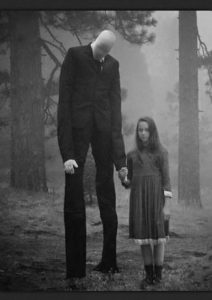
Are We Accidentally Bringing Slenderman to Life?
Slenderman is the only monster in history whose birthday we know, whose creator we can name, and whose origin story has a timestamp — and he might be the most dangerous entity on the internet right now.
He was born June 8, 2009, conjured by Eric Knudsen on the Something Awful forums as a Photoshop contest entry. No ancient folklore. No campfire origins lost to time. Just a guy with an image editor and a good eye for dread.
And yet, people are seeing him.
Not in stories. Not in creepypastas. In their yards, in the trees at the edge of their property, outside their windows at 3 a.m. Tall. Thin. Faceless. A creature that didn’t exist seventeen years ago is now appearing in encounter reports from across the country. The question that should unsettle all of us isn’t whether Slenderman is real.
It’s whether we’re making him that way.
He Was Fiction. Then People Started Seeing Him.
Unlike every other entity in the paranormal catalog — Bigfoot, shadow people, the dogman — Slenderman came with documentation. We watched him get built from the ground up. We know the blueprint.
That makes the encounter reports stranger, not easier to explain.
The simplest answer is misidentification. A tall man standing at a tree line at dusk, a shadow at the wrong angle, a shape glimpsed through a window at night. The mind fills in the blanks with whatever template it’s been given, and for millions of people since 2009, that template is Slenderman. That’s the rational explanation, and it’s a good one.
But it doesn’t explain everything. And it doesn’t sit easily alongside what paranormal researchers have documented about how belief works — and what it can produce.
One Woman, One Monk, and a Warning From Tibet
In 1929, Belgian-French explorer Alexandra David-Néel published an account of something she’d done while living and traveling through Tibet. She wanted to test whether the concept of the tulpa — a being created entirely through focused mental concentration — was real.
A tulpa, in Tibetan tradition, is exactly what it sounds like. A thought given enough energy and focus that it takes on a life of its own.
David-Néel chose her subject deliberately. She wanted to avoid being influenced by the Lamaist deities painted on every wall around her, so she imagined a monk. Short. Fat. Cheerful. Harmless. After months of isolation and concentration, the phantom monk appeared. He began sharing her quarters. He followed her on travels through the countryside. He performed small actions she hadn’t directed.
Then a herdsman visited her camp and saw the monk sitting nearby. He assumed it was a real lama and went to prepare tea.
David-Néel’s creation was visible to someone else.
What happened next is the part nobody talks about. The monk changed. His face grew leaner. His expression shifted from jolly to something she described as “vaguely mocking, sly, malignant.” He stopped listening to her. He started showing up when she hadn’t called him. In her own words, he had “escaped her control.”
It took her six months of concentrated effort to dissolve him.
One person. One focused mind. Six months to undo what it had made.
Eight People Built a Ghost From Nothing
Fast forward to 1972. A team of eight researchers from the Toronto Society for Psychical Research set out to answer a controlled version of the same question: can a group of people will an entity into existence?
They invented a fictional man. Philip Aylesford, an aristocratic Englishman from the 1600s, complete with a tragic backstory, a portrait, and historical inaccuracies deliberately built into his biography to prove he was made up.
Then they tried to contact him.
For about a year, the group met weekly, sitting together to discuss Philip and meditate on his life under fully lit, controlled conditions. Some members occasionally reported feeling a presence, but nothing concrete occurred.
Then they changed tactics, dimming the lights and replicating the atmosphere of a traditional séance. One night, as they continued their séance, the table suddenly shook. Knocking sounds echoed in the room. Through a system of knocks — one for yes, two for no — Philip began answering questions. When asked about his past, he responded in ways that aligned with the fictional backstory they had written.
A completely invented person was interacting with them. And the phenomena were consistent enough that the Toronto organization decided to try the experiment again with a completely different group of people and a new fictional character. After just five weeks, the new group established contact with their new ghost, Lilith, a French Canadian spy. Other similar experiments conjured entities including Sebastian, a medieval alchemist, and Axel, a man from the future — all completely fictional, yet all producing unexplained communication.
Eight people built something. And then other groups of eight people did it again with different names, different backstories, and the same result.
What Happens When Eight Becomes Eight Million?
Here’s where the Slenderman question stops being hypothetical.
The Philip Experiment worked with eight people in a room in Toronto. Alexandra David-Néel worked alone. The Tibetan lamas who documented tulpa creation were single practitioners in isolation.
Slenderman has been the focus of millions of minds since 2009. Millions of posts, drawings, fan fictions, videos, nightmares, and obsessive return visits to the same images of the same thin, faceless figure. The shared mental blueprint is more detailed, more consistent, and more globally distributed than anything a single monk or a research team could produce.
John Keel, author of The Mothman Prophecies, speculated that reports of ghosts or entities that resembled pop-cultural depictions might actually be thought-forms created by people’s beliefs about them. An episode of the TV show Supernatural explored the same idea, with a character explaining that if twenty Tibetan monks could create a creature through meditation, imagine what ten thousand web surfers could do.
That episode aired in 2007. Two years before Slenderman was born.
Now the number isn’t ten thousand. It’s tens of millions. And unlike the Philip Experiment, there was no controlled setting, no scientist overseeing the process, and no plan to dissolve the result.
Or Something Else Is Wearing His Face
There’s another possibility, one that doesn’t require belief in tulpas at all.
Demonic or oppositional entities, as documented across multiple religious and paranormal traditions, are frequently described as opportunistic. They take the forms that will generate the greatest fear response from whoever encounters them. They adapt.
Slenderman checks every psychological trigger that produces maximum fear. He’s tall, which signals a threat to smaller prey. He’s faceless, which removes the human cues we instinctively rely on to assess intent. He targets children, which activates the deepest protective instincts in adult witnesses. He appears at thresholds — tree lines, doorways, the edges of what we can see.
If something is out there looking for a costume, Slenderman is an obvious choice.
Whether that something is a demonic entity feeding on the fear it generates, a pre-existing shadow presence that has found a convenient new identity, or something that genuinely didn’t exist before 2009 and does now — the encounter reports read similarly either way. A tall thing. No face. Standing at the edge of the visible world. Watching.
The Question That Keeps Getting More Uncomfortable
Dracula has been in the popular imagination for over a century. Nobody is reporting actual vampire encounters based on Bram Stoker’s novel. Frankenstein’s monster is universally recognizable, and yet no one claims to have seen him shambling through the woods.
Slenderman is different, and that difference matters.
There’s something about the way the figure was designed — or the way it grabbed the collective unconscious — that crossed a line the others haven’t. People don’t just enjoy being scared by Slenderman. People believe, on a gut level they can’t fully explain, that he could be real. That feeling of plausibility is exactly what the Tibetan tradition and the Philip Experiment both identified as the necessary ingredient for a thought-form to take hold.
What a single focused mind can produce in six months, what eight people in a lit room in Toronto produced in about a year — we’ve been pouring that same energy into one entity, from every corner of the world, for seventeen years.
David-Néel eventually dissolved her monk. It took six months of intense effort.
Nobody is trying to dissolve Slenderman.
Have you encountered something that matches Slenderman’s description — a tall, thin, faceless figure you can’t explain? We want to hear from you. Send your report to Reports@ParaRational.com.


